
Tyrewise has some big targets for what happens to Aotearoa New Zealand’s end-of-life tyres.
We want 80% of the country’s waste regulated tyres to be processed into products and sold into the domestic market by year four of the scheme’s operation and 90% by year six. That’s up from an estimated 40% (or 35,500 tonnes) when the scheme started in 2024.
We already have a lot of processing capacity in Aotearoa New Zealand, particularly in the North Island, so we’re very focused on supporting and developing innovation and investment to create the end markets for the processed products.
A waste hierarchy for tyres
You’ve probably heard of the waste hierarchy that has ‘reducing consumption’ as the most desirable action for reducing waste, while sending end-of-life products to landfill is the least desirable. But what does that look like applied to tyres?
Luckily for us, the World Business Council for Sustainable Development has already worked with global tyre manufacturers and recyclers to map material uses to a hierarchy and recovery matrix specifically for tyres.
This is the hierarchy we use when we assess applications for new processing plants or end uses for recycled rubber material as well as the weighting we use to apply incentives to stimulate market demand.
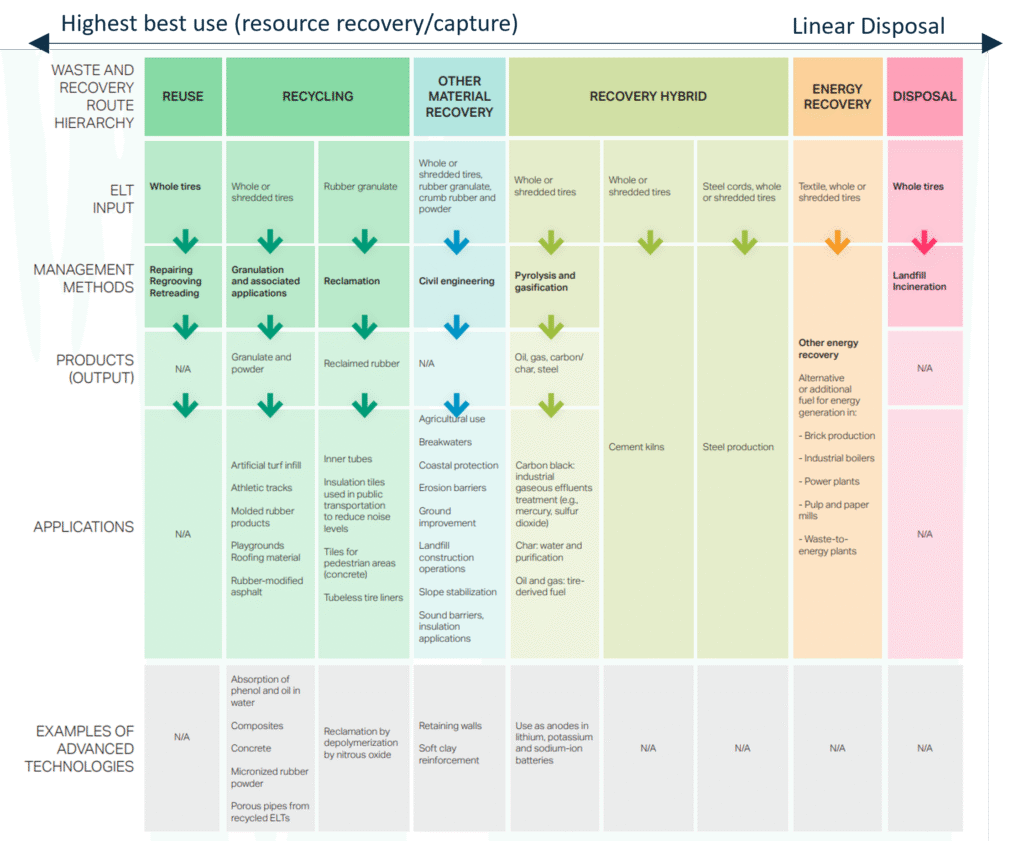
End-of-life tyre uses
While the scheme doesn’t have much influence to reduce the number of tyres New Zealanders use (the very top of a typical waste hierarchy), and we don’t manufacture tyres domestically, we do support the opportunity for reuse (retreading of truck tyres) in New Zealand, and there are lots of opportunities for recycling and repurposing.
Some examples of this are uses in roading and other civil engineering applications or in construction products, like earthquake resilient building foundations.
Other examples are the use of rubber granules in a paving mix designed for engineered water conservation in built environments. One of our partners, Porous Lane by Watersmart uses such a mix in permeable pavements.
A little but further down the waste hierarchy are “hybrid solutions” where we can recover both energy and products which have other uses.
For example, this is the case for one of our partners Golden Bay Cement, where they use tyre-derived fuel in their cement kiln, but also use what remains after that in the manufacture of Cement itself (reducing consumption of mined iron sand).
We’re working to develop more
To help develop solutions that are more desirable according to the matrix, Tyrewise has a technical advisory group dedicated to market development, as well as the Tyrewise Fund. It will have up to $7 million available each financial year to encourage innovation and business opportunities. The fund is looking to fund projects that have the potential to advance:
- Research & Development
- Emerging Markets (circular solutions)
- Community Development
